Railsimroutes.net

Railsimroutes.net

Railsimroutes.net - openBVE add-ons, media and news

 You are here: Home > Projects & Downloads > Miscellaneous > PC Specifications and Add-on Development 

▪ Miscellaneous

In the Railsimroutes.net Miscellaneous section, you can find various other information or downloads, which don't fit neatly into other projects sections, or which don't even necessarily involve train simulation or railways. This section might be expanded over time.

▪ Development PC Specs - Introduction

Project banner
I know some of you like to know what hardware I develop my routes on, perhaps because you're not sure what components should be used in a computer system suited to openBVE or BVE Trainsim, or partly out of curiosity, or partly so you can get an idea about what kind of system might be needed to see a similar level of performance to that which I experience. Apart from my first ever PC, I've assembled all my computer systems myself, as usually a much better computer that's suited to my needs can be built this way. Occasionally I'm asked what software I use for add-on development as well, or what techniques I use. On this page you can find out what hardware I'm developing my routes on, along with what I've developed on in the past, as well as see what kinds of add-ons I've been able to produce thanks to each new generation of hardware.

I use a variety of software for openBVE add-on development, programming, and website design, and in most cases, I prefer to use open source software. For openBVE add-on development, the primary tools are openBVE's Route and Object Viewer utilities, together with Notepad++ for edting text files. Textures are edited using both Paint Shop Pro and GIMP, and I now edit audio files using Audacity. My YouTube videos are edited using Ulead Media Studio Pro and VirtualDub, and encoded using the Xvid codec prior to being uploaded. Where programming is concerned, I use the C# IDE SharpDevelop, with FxCop, StyleCop and .NET Reflector installed. Sometimes I dabble with other programming languages, in which case I use CodeBlocks or Dev-C++. This website is designed using several tools; mostly Notepad++, but also Microsoft Visual Web Developer 2010 Express. Testing is done with various browsers, with the site available on localhost via Apache Webserver, PHP and MySQL, these being installed and configured using WampServer. Lastly, I use VirtualBox quite frequently for any testing I need to do with other operating systems, or if I want to use a sandboxed environment for any reason.

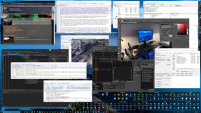
One the best things I've ever done as far as hardware is concerned, was to get a high resolution WUXGA 1920x1200 pixel widescreen TFT monitor. The extra space makes a huge difference in terms of productivity and comfort. For those of you who enjoy seeing what other people's desktops look like, here's mine:

Screenshot Screenshot

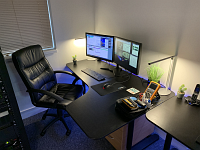
▪ Development PC -- Where the Magic Happens

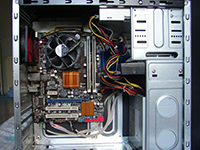
My current development system is built to be fast enough to cope with anything I'm likely to be doing for quite some time. Faster hardware consumes more power, so power saving technologies are enabled as well, and the CPU isn't being overclocked so it'll have a longer life. The following openBVE add-ons are being developed on it:

- Birmingham Cross-City South v2.0
- Watford Junction to Rugby

Main PC Specifications
CPU: Intel Core 2 Quad Q9650 [Yorkfield Core, 45nm, 3.00GHz, 1333MHz FSB, 12MB Cache, E0 Stepping]
-- 3DMark06 (Default Settings) - CPU Score: 4981
-- Windows 7 Experience Index (Processor) - 7.3
Motherboard: Gigabyte GA-EP45-UD3R rev. 1.1 BIOS ver. F12 [Northbridge: iP45 Express, Southbridge: ICH10R; Socket 775]
RAM: 6GB PC2-6400 DDR2 SDRAM [CL5-5-5-15, Dual channel]

SiSoftware Sandra Lite 2009
Int Buff'd iSSE2 Memory Bandwidth: [7.14 GB/s]
Float Buff'd iSSE2 Memory Bandwidth: [7.16 GB/s]
Memory (Random Access) Latency: [81 ns]
Memory (Linear Access) Latency: [11 ns]

Windows 7 Experience Index (RAM): [7.3]
Graphics: NVIDIA GeForce GTX 260, 896MB, PCI-E 2.0(x16) [GT200b GPU, 55nm, 216 Cores, Core: 590MHz, Mem: 999MHz Shader: 1296MHz]
[ForceWare 195.62 drivers; card is permanently forced to remain in Low Power 2D mode via registry entry unless extra performance is needed occasionally]

3DMark06 Basic v1.0.2 (Default Settings)
SM2.0 Score: [6468]
HDR/SM3.0 Score: [6925]

FurMark v1.6.5 (AAx8, AFx16, 1280x1024, Time: 60000ms)
o3Marks: [1721]
FPS (min/max/avg.): [25 / 38 / 29]

openBVE framerates
(Windows 7 64-bit, 600m viewing distance, Anisotropic filtering (Sharp), fullscreen 1920x1200, AA: 16xQ, AF: 16x):
Cross-City South v1.31 High Detail, Redditch, with class 323 3D cab: [390 fps]
Cross-City South v1.31 High Detail, Barnt Green, with class 323 3D cab: [290 fps]

Windows 7 Experience Index (Graphics): [7.2]

Information IconopenBVE works extremely well with this graphics card and these drivers, however BVE 4 seems incompatible with NVIDIA's Windows 7 drivers, therefore I no longer use BVE 4.
Audio: On-board Realtek ALC889A High Definition Audio Codec
Logitech X-230 2.1 Speakers
Internal Storage: Corsair Extreme Series X32 (CMFSSD-32D1) 32GB 2.5" SSD [SATA-II 3Gb/s, 64MB Cache, AHCI, Firmware v2.0 with TRIM]

ATTO Disk Benchmark (default settings)
Max Read Transfer Rate: 208547 [KB/s]
Max Write Transfer Rate: 94223 [KB/s]
Min Read Transfer Rate: 11392 [KB/s]
Min Write Transfer Rate: 4654 [KB/s]

SiSoft Sandra Lite 2010
Read Performance: [150 - 222 MB/s]
Random access time: [43 µs]

Windows 7 Experience Index (Hard Disk): [7.2]


Western Digital VelociRaptor WD1500HLFS-01G6U1 150GB 2.5" [SATA-II 3Gb/s, 10000rpm, 16MB Cache, AHCI, Firmware v04.04V02]

ATTO Disk Benchmark (default settings)
Max Read Transfer Rate: [126028 KB/s]
Max Write Transfer Rate: [128159 KB/s]
Min Read Transfer Rate: [11307 KB/s]
Min Write Transfer Rate: [10772 KB/s]

SiSoft Sandra Lite 2010
Read Performance: [74 - 121.72 MB/s]
Random access time: [6.87 ms]

Windows 7 Experience Index (Hard Disk): [5.9]


Western Digital Caviar Blue WD2500AAKS-00VSA0 250GB [SATA-II 3Gb/s, 7200rpm, 16MB Cache, AHCI, Firmware v01.01B01]

ATTO Disk Benchmark (default settings)
Max Read Transfer Rate: [104857 KB/s]
Max Write Transfer Rate: [103426 KB/s]
Min Read Transfer Rate: [4424 KB/s]
Min Write Transfer Rate: [5941 KB/s]

SiSoft Sandra Lite 2010
Read Performance: [51.79 - 101 MB/s]
Random access time: [16.25 ms]

Windows 7 Experience Index (Hard Disk): [5.9]

Information IconFaster hard disks can help when loading high numbers of 3D objects, as with Watford Junction to Rugby

The SSD is used to store the operating system only. In order to minimise the amount of writes to the SSD, and hence maximise the life expectency of the drive's MLC NAND flash cells, the ProgramData and Users directories are stored on the WD VelociRaptor, with NTFS directory junctions pointing to these folders on the SSD, making it appear to applications as though these folders also reside on the SSD. This gives great real-world performance, mainly due to lower access times, and leaves plenty of free space on the SSD, which is important for performance with such a storage device. Also, both the SSD and 2.5 inch WD VelociRaptor drives only consume about the same amount of power as a single conventional 7200rpm 3.5 inch hard drive, while performing much better.
External Storage: Maxtor DiamondMax Plus 9 160GB 6Y160P0 [8MB cache, Ultra-ATA/133, via USB2.0 HDD Enclosure]
Optical Storage: Samsung SH-S223L/BEBE 22x DVD±R, 8x DVD±DL, DVD+RW x8/-RW x6, x12 RAM w. Lightscribe (SATA, Firmware v. SB02)
Display: Samsung Syncmaster 2443BW 24" 5ms TFT/TN LCD @ 1920x1200 [Samsung panel]
Input: Microsoft Comfort Curve 2000 Keyboard
Logitech MX400 Performance Laser Mouse
Saitek P2600 Gamepad
TV Card: Hauppauge WinTV-HVR 900H Hybrid TV Stick
Case: akasa Zen Silent-Cool [Black]
Power Supply: Corsair VX550W ATX12V v2.2 [80 Plus, +3.3V: 30A, +5V: 20A, +12V: 41A]
Information IconAfter having three cheap PSUs fail in recent years, I thought it was about time I fitted something decent in my main system. This PSU is capable of delivering more power than is needed, so fewer amps are actually used, and the PSU will last longer as it's not being over-stressed.
Internet and LAN: Onboard Realtek 8111C Gigabit Ethernet Controller (10/100/1000 Mbps)

Netgear RP614v2 4-port Cable Router with 10/100 Mbps Switch
Cat 5e cabling for LAN, approx. 94 Mbit real-world throughput

Cisco/Scientific Atlanta WebSTAR EPC2100R2 Cable Modem
QoS: 10 Mb downstream, 512 kb upstream, DOCSIS 1.1
Operating System(s): Windows 7 Home Premium 64-Bit

Windows Experience Index: [7.2]
Processor: [7.3]
Memory: [7.3]
Graphics: [7.2]
Gaming graphics: [7.2]
Primary hard disk: [7.2]


Ubuntu 9.04

Windows XP Home Service Pack 3

▪ Previous PC Specifications (2009 - Present)

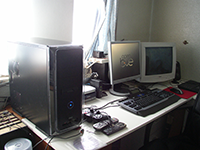
Currently a spare PC, this machine will be used occasionally for testing the performance of routes on slower hardware. This system was built on a tight budget at the start of 2009, re-using some old hardware. It was used during the development of the following openBVE add-ons:

- Birmingham Cross-City South v1.4
- Watford Junction to Rugby

Secondary Development PC Specifications
CPU: AMD Athlon 64 X2 4200+ @ 2.21GHz [Brisbane Rev. G2]
-- 3DMark06 (Default Settings) - CPU Score: 1688
Motherboard: Gigabyte GA-M56S-S3 [nForce 560 MCP, Socket AM2]
RAM: 2GB PC2-6400 CL5-5-5-15 DDR2 SDRAM [Dual channel]

SiSoftware Sandra Lite 2009
Int Buff'd iSSE2 Memory Bandwidth: [7.31 GB/s]
Float Buff'd iSSE2 Memory Bandwidth: [7.29 GB/s]
Memory (Random Access) Latency: [104 ns]
Memory (Linear Access) Latency: [25 ns]
Graphics: ATi Radeon HD 2600 Pro 256MB DDR2 PCIe [Catalyst 9.2 drivers]

3DMark06 Basic v1.0.2 (Default Settings)
SM2.0 Score: [1063]
HDR/SM3.0 Score: [1348]

FurMark v1.6.5 (AAx8, AFx16, 1280x1024, Time: 60000ms)
o3Marks: [144]
FPS (min/max/avg.): [2 / 5 / 2]

openBVE framerates
(Windows XP 32-bit, 600m viewing distance, Bilinear, fullscreen 1280x1024, AA: 8x, AF: 16x):
Cross-City South v1.31 High Detail, Redditch: [56 fps]
Cross-City South v1.31 High Detail, Barnt Green: [40 fps]

Information IconThis card (together with the Athlon 64 X2 4200+ CPU above), is a little too slow to handle full anti-aliasing with animated objects in openBVE -- framerates are acceptable, but there is some stuttering. This card also exhibits some transparent texture edge colouration issues in BVE 4.
Audio: On-board Realtek ALC888 Audio Codec
Internal Storage: Western Digital Caviar Green WD10EACS-00D6B1 1TB [SATA-II 3Gb/s, 5400rpm, 16MB Cache, AHCI, Firmware v01.01A01]

ATTO Disk Benchmark (default settings)
Max Read Transfer Rate: [99420 KB/s]
Max Write Transfer Rate: [99975 KB/s]
Min Read Transfer Rate: [6463 KB/s]
Min Write Transfer Rate: [9297 KB/s]

SiSoft Sandra Lite 2010
Read Performance: [49.21 - 94.42 MB/s]
Random access time: [10 ms]

Windows 7 Experience Index (Hard Disk): [5.9]
Optical Storage: LG GH22LS30 22x DVD±R Lightscribe (SATA)
Display: Samsung Syncmaster 710T 17" 12ms TFT/TN LCD @ 1280x1024
Input: Logitech G15 Gaming Keyboard
Microsoft Wheel Mouse Optical
TV Card: Hauppauge WinTV PCI
Internet and LAN: Onboard Realtek 8211BL Gigabit Ethernet Phy (10/100/1000 Mbps)
Edimax nLite EW-7711UTn Wireless USB Adapter (802.11b/g and 802.11n 150 Mbps)
Case: Generic ATX Case
Power Supply: Generic 600W ATX PSU
Operating System(s): Windows XP Home Service Pack 3
Ubuntu 10.04

▪ Previous PC Specifications (2003 - Present)

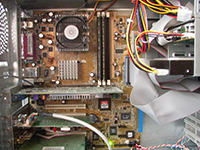
Currently used only occasionally for testing the performance of routes on slower hardware, and for Linux testing, my previous system was stable and served me well for six years as my main PC; it was used for the development of the following BVE 2 and 4 add-ons:

- Birmingham Cross-City South v1.2 - v1.31
- Watford Junction to Rugby

Backup Development PC Specifications
CPU: AMD Athlon XP 2400+ [Thoroughbred-B @ 2.0GHz]
Motherboard: ASUS A7V8X Gold Rev. 1.04 [VIA KT400 Northbridge, VIA VT8235 Southbridge, Socket A]
RAM: 1.00GB PC2100 DDR-SDRAM [2.5-3-3-7 timings] (Originally 256MB)
Graphics: Creative nVIDIA GeForce3 Ti200 64MB [AGP 8x] (Up until 2004)
Sapphire ATi Radeon 9600XT 128MB DDR [AGP 8x] (2004-2008)
XFX nVIDIA GeForce 6600GT 128MB DDR3 [AGP 8x] (2008-Now)
Audio: On-board Realtek ALC650 audio
Internal Storage: Maxtor 5T020H2 Diamond Max Plus Ultra ATA/100 20.4GB
Optical Storage: Sony DVD RW DRU-510A
Creative CD-RW Drive
Display: Iiyama Vision Master 1402 17" CRT
Input: Saitek K140 Backlit Slimline Multimedia Keyboard
CH Virtual Pilot Pro
Internet and LAN: Onboard Broadcom 4401 Fast Ethernet Controller (10/100 Mbps)
Creative Modem Blaster v.92 PCI
Case: Generic ATX Case
Power Supply: Generic 550W ATX PSU
Operating System(s): Windows 98 Second Edition
Windows XP Home Edition
Ubuntu 10.04

▪ Previous PC Specifications (2001 - 2003)

This computer was a joy when first used, stable, and a significant step up from my previous 400MHz Pentium II system in terms of performance and responsiveness, but sadly it's no longer with us. The following add-ons were developed on this machine:

- Birmingham Cross-City South v1.0
- Watford Junction to Milton Keynes Central v1.1

Former Development PC Specifications
CPU: AMD Athlon Thunderbird 1.2Ghz [266Mhz FSB]
Motherboard: EPoX EP-8K7A [AMD-761 Northbridge, VIA VT82C686B Southbridge, Socket A]
RAM: 256MB PC2100 DDR-SDRAM [2.5-3-3-7 timings
Graphics: 3dfx Voodoo5 5500 AGP 64MB (Up until 2002)
Creative nVIDIA GeForce3 Ti200 64MB [AGP 4x] (2002
Audio: On-board VIA VT82C686B integrated sound
Internal Storage: Maxtor 5T020H2 Diamond Max Plus Ultra ATA/100 20.4GB
Optical Storage: Panasonic CR-585-B 24x IDE/ATAPI CD-ROM
Creative RW121032E CD-RW Drive
Display: Iiyama Vision Master 1402 17" CRT @ 1152x864
Input: Generic keyboard and mouse
CH Virtual Pilot Pro
TV Card: Hauppauge WinTV PCI
Internet and LAN: Linksys LNE100TX Etherfast 10/100 Mbps PCI NIC (v5.1)
Diamond SupraMax 56Kbps USB modem (K56flex/v.90)
Case: Generic ATX Case
Power Supply: Generic 300W ATX PSU
Operating System(s): Windows 95
Windows 98 Second Edition

▪ Previous PC Specifications (1998 - 2001)

The following add-ons were developed on the following system (sadly no longer with us):

- Watford Junction to Milton Keynes Central v1.0

Former Development PC Specifications
CPU: Intel Pentium II 400 MHz [Deschutes core, 100Mhz FSB]
Motherboard: Supermicro P6SBA [Intel 440BX Chipset, Slot 1]
RAM: 128MB PC100 SDRAM
Graphics: ATi Xpert 98 8MB [Rage Pro Turbo, AGP 2x] (Until 2000)
3dfx Voodoo5 5500 AGP 64MB (2000)
Audio: Sound Blaster Pro 16 Clone [ISA]
Internal Storage: Various: 1.2 - 6.4GB Seagate drives
Optical Storage: Panasonic CR-585-B 24x IDE/ATAPI CD-ROM
Display: Packard Bell 14" CRT @ 1024x768
Input: Generic keyboard and mouse
CH Virtual Pilot Pro
TV Card: Hauppauge WinTV CinemaPro [ISA]
Case: Generic ATX Case
Power Supply: Generic 250W ATX PSU
Operating System(s): Windows 95
Windows 98 Second Edition

▪ Previous Computer Specifications (Late 80s - 1998)

Prior to starting out with BVE and the Pentium II system, my previous computer comprised an Intel Pentium 100MHz (P54C) CPU, 16MB RAM, Diamond Stealth 64 DRAM PCI and Orchid Righteous3D (3dfx Voodoo I) graphics cards; the addition of the latter seemed amazing at the time.

Before that, my first PC (and last ever ready-built, brand name system) was a Packard Bell Executive Multimedia PC running Windows for Workgroups 3.11 and MS-DOS 6.22, with an Intel 486 SX2 50Mhz CPU, 4MB RAM, 2x Matsushita-Kotobuki/Panasonic CD-ROM drive, 341MB Seagate hard disk, and on-board Cirrus Logic graphics solution. Both systems still work, although the P100 motherboard's floppy disk controller is dead.

Before the PCs, came the Commodore Amiga A600 running Workbench 2.0 which introduced me to GUIs, computer based graphics design and animation, sound sampling, and tracker music. My first computer was the Sinclair ZX Spectrum +2A, which introduced me to BASIC and simple train/flight sims.

Content last updated: 11th August 2010
Unique visitors: